Jack Merridew
Lord of the FliesJack Merridew’s transformation from choir leader to armed rival chief charts the island’s shift from elected, rule-bound leadership toward power enforced by hunting and threat. He begins with the confidence and habits of a school head boy; as rescue recedes and the group’s fears deepen, he builds an authority that offers meat, protection, and release from shame, but ends in open violence against Ralph and Piggy.
Identity and First Leadership
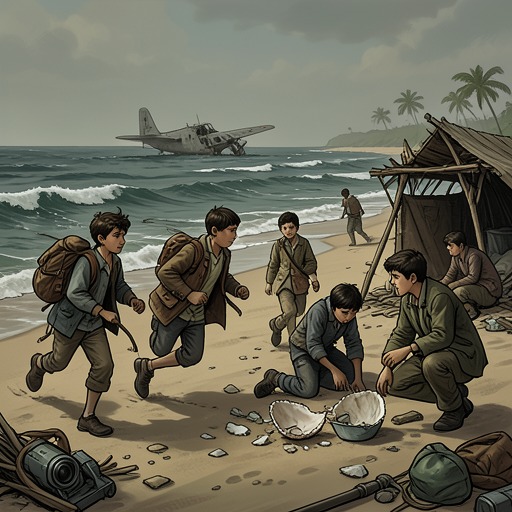
Jack first appears leading a marching party of choirboys, dressed like them in black cloaks and square caps, but distinguished by a gold badge. Tall, thin, freckled, and red-haired, he arrives expecting a man with a trumpet and a ship. When he learns there are no adults, he accepts that the boys must look after themselves, yet immediately asserts his own claim to command. He calls his group to attention as “Choir!” and, when one boy collapses, treats the fainting as a familiar nuisance rather than a reason to stop the meeting.
His first claim to chief rests on institutional rank: he says he is chapter chorister and head boy, and adds that he can sing C sharp. The assembly instead elects Ralph, whose earlier use of The conch has made him a focus for the group. Jack’s choir is the only group to vote for him; the other boys choose Ralph, and Piggy eventually raises his hand as well. Jack blushes with mortification, but Ralph gives him responsibility for the choir. Jack names them hunters, and the immediate setback becomes a role from which he can develop a different kind of authority. For a moment, the two boys smile at one another with shy liking, a fragile note of mutual recognition before their competition hardens.
Hunting, Duty, and the Face Paint
Jack’s position as hunter is established against the need to keep The signal fire burning. When Ralph reports that the boys have seen pigs, Jack seizes on the prospect of hunting for meat. Earlier, he had tried to kill a pig and failed; afterward, he explains that the hunt drew him on even when the others had returned. His eyes show how strongly the wish to kill has taken hold, while Ralph’s demand for help with the shelters exposes the practical cost: the shelters remain unfinished because Jack’s hunters have gone swimming or hunting instead of working.
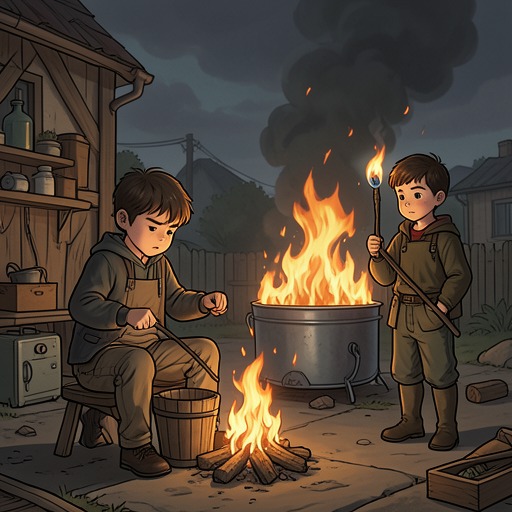
At first, Jack can still speak in the language of collective rules. On the mountain, he agrees that the boys need rules and says his hunters will take responsibility for tending the fire and watching for a ship. But the promise is unstable. The hunters allow The signal fire to go out while they pursue a pig, and a ship passes without seeing a smoke signal. When Jack returns with the carcass, his excitement over the hunt collides with Ralph’s repeated accusation that he has neglected the fire. Jack insists that the hunt was exhilarating and boasts that he cut the pig’s throat; the boys’ chant, “Kill the pig. Cut her throat. Spill her blood,” makes the kill a collective performance as well as a source of food. Jack’s pride in the hunt cannot undo its consequence: the missed ship has made his choice a direct threat to rescue.
Face paint gives Jack a way to pursue hunting while changing how he appears to others. He applies white clay, red pigment, and a black charcoal stripe, studying the pattern in the water until he sees an “awesome stranger” rather than himself. The disguise frees him from shame and self-consciousness; his laughter turns to a bloodthirsty snarl as he dances, and his painted face draws the boys’ attention. He calls the pattern hunting camouflage, but its effect reaches beyond concealment: it becomes a mask behind which he can act with less restraint. When he later appears painted at Ralph’s camp, he can address the boys without the embarrassment that had marked his public challenge to Ralph.
Rivalry with Ralph and the Breakaway
The conflict between Jack and Ralph is a contest over what the group is for. Ralph emphasizes shelters, orderly assemblies, and The signal fire; Jack’s priority is hunting. When the boys debate ghosts and the beast, Jack openly rejects the authority of rules: “Bollocks to the rules!” He promises that if there is a beast, they will hunt it down, then leaves the assembly amid its disorder. Ralph fears that without the shared rules the boys will become animals, while Jack treats hunting strength as the more convincing answer to danger.
Their rivalry sharpens when Jack calls an assembly and claims that the boys have seen the beast on the mountain. He recasts Ralph’s criticism of the hunters as an accusation of cowardice and argues that Ralph is not a proper chief: Ralph, he says, is neither a hunter nor a prefect, and merely gives orders. Jack tries to turn the meeting into a vote against Ralph, but the boys do not raise their hands. The silence leaves Jack publicly humiliated. He sets The conch carefully on the grass, says he will no longer be part of Ralph’s lot, and announces that anyone who wants to hunt with him may come. His departure is not simply a loss of office. It is the creation of a rival group organized around his own power.
Jack quickly gives the new group a program. He says they will forget the beast, hunt, and feast; he also promises to leave some of a kill for the beast in the hope that it will not bother them. The contradiction is revealing: he tells the boys to forget the source of their fear while incorporating it into a hunting ritual. Meat and shared action bind the group more effectively than debate. When Jack later visits Ralph’s camp, he advertises life with his tribe as hunting, feasting, and fun, and offers meat to draw the boys over. He claims that his hunters will protect them from the beast. Ralph appeals to his election and the duty to keep The signal fire alight, but Jack answers that The conch does not count at his end of the island. Authority, in his settlement, belongs to the chief who can feed and protect the group.
Chief, Force, and the Final Confrontation
Jack’s invitation to join his tribe is backed by an increasingly explicit threat. When Ralph and Piggy come to Castle Rock to demand Piggy’s glasses, Jack tells Ralph to keep to his own end and leave the tribe alone. Ralph accuses him of stealing the glasses and argues that they would have given Jack fire if he had asked. Jack makes a rush at Ralph with his spear; Ralph parries, and the two use their spears like swords, striking and pushing at close range without daring to use the points lethally. Their leadership dispute has become a physical confrontation over territory, supplies, and the right to command.
Piggy’s attempt to appeal to rules and reason does not restore the earlier order. Holding The conch, he asks whether it is better to have rules and agreement or to hunt and kill. Roger releases the great rock from above. It strikes Piggy, who falls from the cliff, and The conch shatters into white fragments. Jack did not release the rock, but he immediately turns the catastrophe into a declaration of power. He shouts that the conch is gone, claims, “I’m Chief!”, and throws his spear at Ralph, wounding him. The tribe advances, and Ralph runs. With The conch destroyed and Piggy dead, the symbols and people who had challenged Jack’s rule have been violently removed; his own claim now rests on command, weapons, and the tribe’s force.
Narrative Role and Significance
Jack’s rise is not a simple rejection of authority: he repeatedly borrows its forms, from the choir’s disciplined ranks to assemblies, rules, and the title of chief. What changes is the basis on which obedience is demanded. The elected leadership associated with Ralph depends on agreement and shared duties; Jack’s leadership binds followers through hunting, food, promised protection, spectacle, and fear. His early declaration that the boys are not savages sits in sharp contrast with his later celebration of the hunt and rejection of rules.
The face paint condenses this change into a visible action. It hides Jack from his own embarrassment even as it makes him more commanding to the other boys, turning personal inhibition into group spectacle. The conch’s destruction then gives physical form to the collapse of the order he once claimed to respect. At the end of Ralph’s flight, the chase is interrupted when he reaches the beach and encounters a naval officer, who has seen the smoke. The novel’s final reversal is therefore not Jack’s negotiated defeat: it is the sudden arrival of an outside authority while the island and its boys are caught in the consequences of their violence.